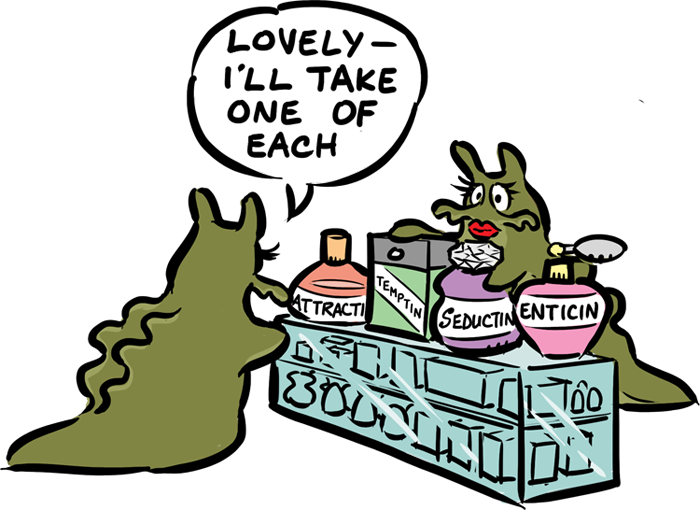
The sea slugs, Aplysia californica, live in the vast ocean. It can be very difficult for them to find a mate amidst the large body of water. To solve this problem, they frequently congregate near the shore during the mating season to increase their chances of finding a mate. In addition, they rely heavily on a group of chemicals called "pheromones" to attract potential mates. Pheromones are chemicals produced by one organism to influence the behavior or physiology of another organism of the same species. The sea slugs make and release a "bouquet" of pheromones with tell-tale names such as attractin, temptin, seductin, and enticin. These pheromones collectively lure other slugs over in a state of sexual frenzy to initiate mating.